
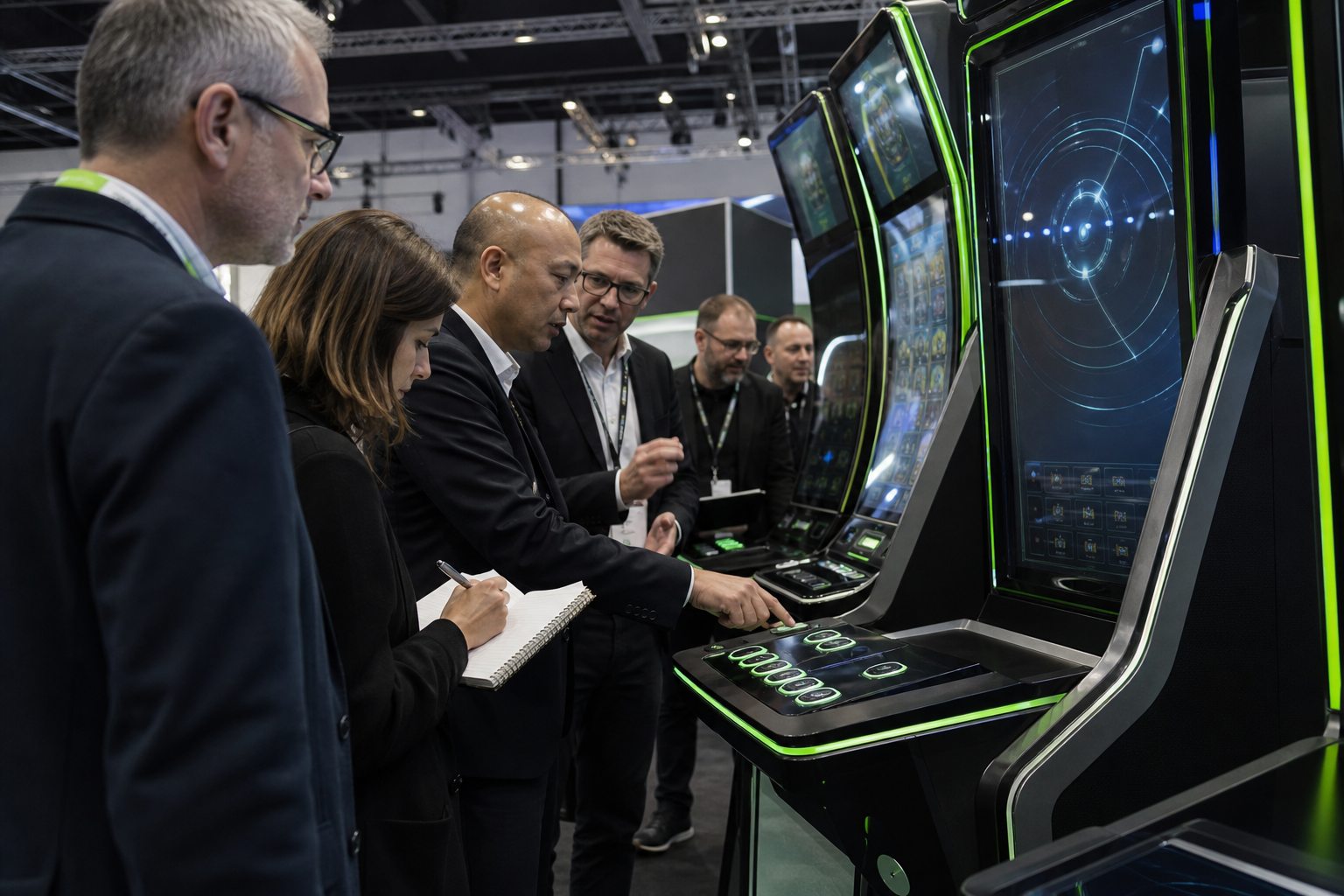
The 2026 equipment cycle is not defined by a single screen size or cabinet silhouette. It is defined by the operator’s ability to run content, data, service and compliance as one reliable system.
1. Cabinet architecture
Modern core cabinets are converging around high-resolution portrait or dual-screen formats, integrated audio, programmable lighting and ergonomic decks. Premium formats go larger and taller, but scale carries trade-offs: floor density, neighbouring-machine visibility, heat, power draw, installation complexity and the number of titles available for that footprint.
Konami’s Solstice 49C, for example, uses a 49-inch curved portrait display with audio above and below the screen. The manufacturer reported that the cabinet led an external U.S. and Canada portrait-upright index soon after launch. Aristocrat’s Baron Upright has been presented as a global platform with more than 10,000 installations across Australia and New Zealand before broader market deployment. Those disclosures show two different launch strategies—new-product indexing and installed-base proof—but neither substitutes for property-level trials.
What operators measure
A serious trial compares average daily win, occupancy, carded-play mix and time on device with the surrounding bank and property baseline. It also tracks out-of-service time, recurring component faults, cleanability, parts access and staff time per intervention. A cabinet that earns well but creates more service hours can shift cost rather than create value.
2. Content and hardware are inseparable
Cabinet performance usually enters the market attached to launch titles. That makes attribution difficult: is the result created by the game, the form factor, placement, novelty, merchandising or the combination? Operators increasingly rotate multiple titles through the same platform and extend tests beyond the first promotional window. A useful roadmap shows approved markets, planned releases, conversion cost and how long the manufacturer expects to support the hardware.
Hardware earns its place through a content pipeline and an operating record—not a trade-show reveal.
3. Electronic table games
Electronic table games range from fully automated terminals to stadium configurations linked to live dealers. Their operating case depends on local rules, table availability, labour strategy and player acceptance. The same terminal can sometimes carry several approved games, making the footprint flexible, but configuration and certification are jurisdiction-specific.
Evaluation should include dealer and terminal latency, display clarity, bet confirmation, dispute logs, camera coverage, language support, accessible reach, limit configuration and the process for taking a station offline. A high-capacity stadium also changes surveillance and guest-flow requirements.
4. Casino management systems
Management systems connect devices with accounting, player tracking, bonusing, maintenance alerts and regulatory reporting. Newer architectures are moving toward browser-based tools, contextual event data and combinations of on-premise and cloud services. The commercial promise is faster analysis and fewer isolated databases. The operational risk is a larger dependency map.
Procurement teams should document network segmentation, encryption, identity privileges, update procedures, incident logging, offline behaviour, data residency, recovery targets and the vendor’s right to access diagnostic information. A system demo should include a failed connection and a rollback, not only the ideal journey.
5. Mobile, cashless and financial technology
Mobile wallets and cashless systems can make activity more traceable, support limits and reduce some cash-handling friction. They also add KYC, cybersecurity, device-integrity and consumer-disclosure obligations. The AGA argues that modern payments can strengthen responsible-gaming and law-enforcement visibility; individual jurisdictions decide which methods and workflows are permitted.
In June 2026, Everi announced a property-wide Class II mobile deployment at Prairie Band Casino & Resort. The significance is architectural: the regulated play environment can extend across an approved property while remaining tied to casino systems. It also underlines the need for location controls, session handling, device assurance and clear rules on where play is allowed.
A practical buying framework
| Layer | Questions to ask | Evidence |
|---|---|---|
| Guest experience | Is the interface legible, reachable and clear? Are rules, balances and states unambiguous? | Observed sessions, accessibility review, support logs |
| Economics | Does performance hold after novelty? What is total ownership cost per position? | Controlled floor trial, service time, conversion plan |
| Operations | Can staff access common components? What fails gracefully? | Maintenance drill, parts SLA, recovery test |
| Systems | Which protocols, versions and integrations are supported? | Architecture map, compatibility matrix, certification |
| Compliance | Are required logs, limits, reports and approvals available by jurisdiction? | Lab letter, regulator approval, audit export |
| Security | How are updates signed, access controlled and incidents reported? | Security assessment, patch policy, incident exercise |